
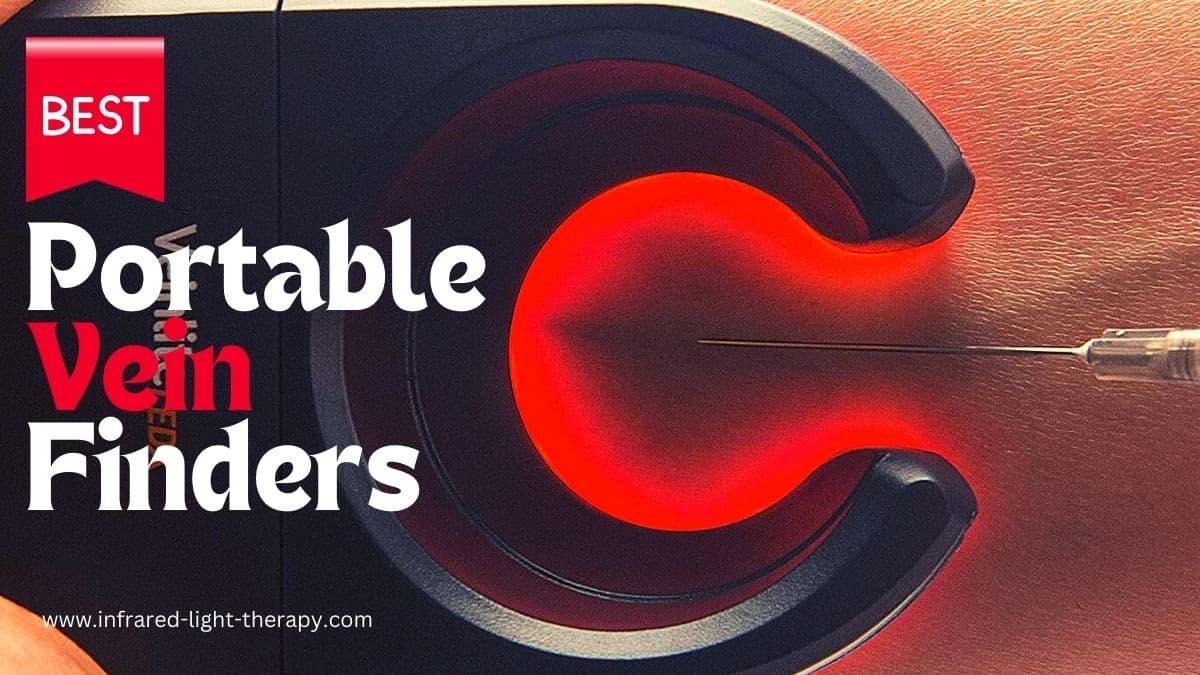
Finding a vein isn’t always easy, especially in children, older adults, or patients with difficult IV access.
A good vein finder can make superficial veins easier to see, but not every device works the same way.
Some use red and orange LED lights against the skin, while more advanced infrared vein viewers use cameras to display or project vein patterns.
I’ve compared four portable vein finders based on how they work, who they’re designed for, ease of use, and price.
Here’s which one I’d choose for emergency care, difficult veins, pediatric use, and smaller budgets.
👉 In a hurry?
See our top 4 picks compared, and below you’ll find our vein finder reviews, how to choose, and the best accessories.
Which Vein Finder Is Right for You?
- Best for EMS and emergency IV access: Veinlite EMS Pro. Portable, 26 LEDs, and a design that helps hold veins in place during access.
- Best for Sclerotherapy and Vein Mapping: Veinlite LEDX. Larger viewing area, 32 LEDs, and a rechargeable battery. Expensive, but designed for vein specialists.
- Best Simple Vein Finder: Venoscope II. A straightforward LED transilluminator for finding superficial veins without complicated controls.
- Best for Babies: Philips Wee Sight. Uses cool red light to help clinicians see tiny veins in newborns and infants.
This post may contain affiliate links at no extra cost to you.
How Do Vein Visualization Devices Work?
Vein finders make blood vessels easier to see by using light.
But there are two different technologies:
LED transilluminators, like Veinlite and Wee Sight, shine red or orange light into the skin. Veins appear as darker lines because blood absorbs some of that light.
Near-infrared vein viewers use invisible infrared light and a camera to detect vein patterns.
Some then project an image of the veins onto the skin.
Both can help clinicians find veins that are difficult to see, but neither guarantees successful IV access.
And because most of the devices below are transilluminators, they’re different from expensive hospital-grade infrared projection systems.
Who Needs an Infrared Vein Finder?
- Emergency departments
- Pediatrics / NICU
- Dialysis units
- Oncology
- Home infusion
- EMS/paramedics
Do Infrared Vein Finders Really Work?
Yes, vein visualization devices can make veins easier to see.
But do they actually improve first-attempt IV success?
The research is mixed.
A 2024 review of 18 pediatric trials found that near-infrared devices reduced the number of attempts and procedure time, but didn’t significantly improve first-attempt success overall.
A 2025 review of adult trials also found no significant overall improvement in first-attempt success.
However, a 2026 review involving 1,022 older adults reported better first-attempt success and shorter procedures with near-infrared assistance.
My take: A vein finder can be a useful extra tool, especially for difficult-to-see veins, but it doesn’t guarantee fewer needle sticks.
The device, patient, and clinician’s experience all matter.
Why a Vein Finder Pays for Itself
A single failed IV attempt costs:
- Additional needle and supply waste
- More procedure time
- Increased patient anxiety
- Higher risk of bruising or infiltration
Even improving first-attempt success by a small percentage can offset the device cost quickly.
How to Choose a Vein Visualization Device
Before buying, here’s what I’d check:
- Patients: Is the device made for adults, newborns, or both?
- Technology: LED transilluminators are compact and simple. Infrared camera systems can provide a larger image but usually cost much more.
- Viewing area: A larger opening can help when mapping superficial veins, but it doesn’t guarantee better visualization of deep veins.
- Battery: Rechargeable devices are convenient for frequent use. AA batteries are easy to replace in the field.
- Cleaning: Check whether disposable covers are required and how much they cost.
- Clinical evidence: Look for studies on the exact device, not just another product from the same manufacturer.
And if you regularly deal with difficult IV access, remember that ultrasound-guided access may be more appropriate than a basic vein finder.
The 4 Best Portable Vein Finders (2026)
Through my research (which included consulting with nurses), here are the 4 best vein lights for caregivers, nurses, doctors, paramedics, and anyone who needs to draw blood accurately and without unnecessary pain.
1. Veinlite EMS Pro – Best for Emergency IV Access
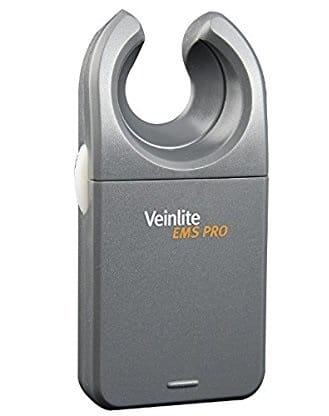
Best for: EMS, emergency departments, and clinicians who need a portable vein finder for everyday IV access.
Why it stands out: Proven improvement in first-attempt IV success in pediatric settings
- Weight – 108 grams
- LED Bulbs – 26 LEDs (18 orange + 6 red + 2 white)
- Opening – 21 mm
- Battery life – Up to 550 minutes
- Warranty: 1 year standard
✅ $369 on Amazon
The EMS Pro is my top choice for nurses and paramedics who regularly deal with difficult IV access.
Its C-shaped opening helps hold the vein in place, while the orange and red LEDs make superficial veins easier to see.
It also includes a pediatric adapter and a white examination light.
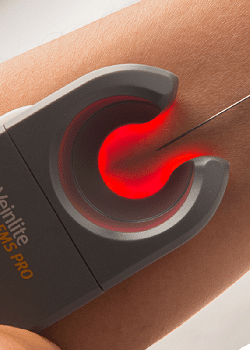
The downside? It’s not rechargeable, and you need disposable protective covers for clinical use.
To use it, you simply dim the room lights, turn the unit on, and apply it directly to the skin at a perpendicular angle.
Scan the skin to find a darkened vein and map the surrounding area for networks and the best venipuncture site.
Here’s a Veinlight video with a nurse demonstrating how she uses it:
Use the Veinlite for:
- Mapping superficial veins
- Varicose veins imaging
- Identifying spider veins
Veinlite Pros
- 26 LED array improves superficial vein contrast
- Ring design reduces ambient light interference
- Lightweight (108g) for mobility
Cons
- May struggle with very deep veins in darker skin
- Uses AA batteries (not rechargeable)
✅ Available on Amazon ($369)
2. Veinlite LEDX – Best for Vein Mapping and Sclerotherapy
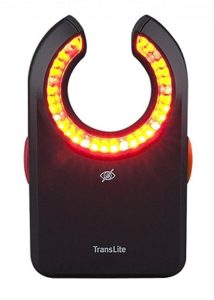
Best for: Vein specialists, sclerotherapy clinics, and professionals who need detailed superficial vein mapping.
Why it stands out: Larger ring diameter and higher LED density for stronger contrast and deeper visualization
- Weight – 83 grams
- LED Bulbs – 32 (24 orange, 8 red)
- Battery – Rechargeable Li-Ion battery (USB charging)
- Opening: 31 mm
✅ $645 on Amazon
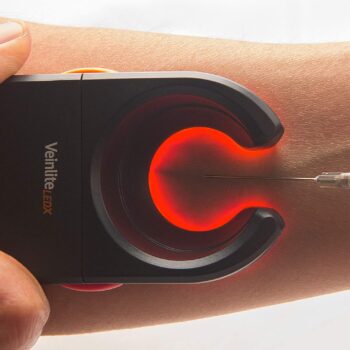
The LEDX stands out for its larger viewing area, which is especially useful when mapping superficial veins before sclerotherapy.
Its C-shaped design also lets clinicians see and stabilize veins during treatment.
Unlike EMS Pro, it has a rechargeable battery, so there’s no need to keep replacing AA batteries.
The downside? It’s expensive, and its larger opening doesn’t mean it can find every deep vein.
The Veinlite LEDX is being used by over 70,000 healthcare professionals (reported by Veinlite).
Its unique design stretches the skin, acts as a tourniquet, and anchors the vein.
Veinlite LEDX Pros
- 32-LED array (24 orange and 8 red) improves contrast in challenging cases
- Larger 31 mm ring blocks ambient light and helps “anchor” veins
- Rechargeable lithium-ion battery (USB charging)
- Designed to stretch skin and enhance superficial vein finding
- Lightweight (83 g) and compact
Cons
- Higher price point
- Does not guarantee visualization if the vein is dehydrated or deeply buried
✅ Available on Amazon ($645)
3. Venoscope Transilluminator II – Best Simple LED Vein Finder
Best for: Vein specialists, sclerotherapy clinics, and professionals who need detailed superficial vein mapping.
Why it stands out: FDA-cleared, simple operation, cost-effective option for homes
- Model: VT03
- Technology: LED transillumination
- Use: Superficial peripheral vein visualization
- Clinical use: For trained healthcare professionals
- Weight – 170 grams
- Batteries – 3 AA batteries
✅ $309 on Amazon
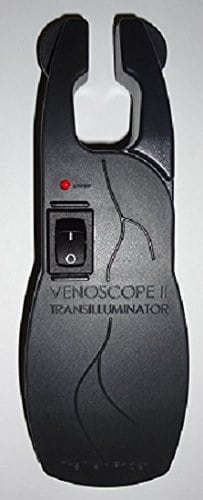
If you want a simple vein finder without lots of extras, the Venoscope II is worth considering.
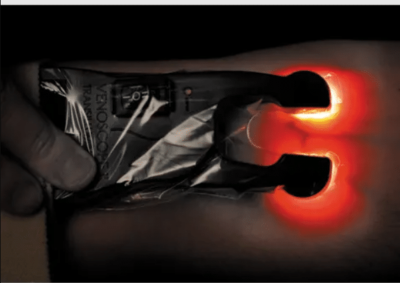
It shines light into the skin to help clinicians spot superficial veins before blood draws or IV placement.
The biggest advantage is its simple design.
You don’t need a camera, screen, or image projection system.
The downside? It’s mainly for superficial veins and won’t replace ultrasound when veins are too deep to identify.
To use it, you prepare the patient (tourniquet, etc.) and dim the light source a bit to a point where the vein light performs best.
If you see the vein as a sharply defined line, it’s near the surface; if it’s fuzzier, it’s deep.
There are 2 power levels to choose from.
Venoscope Pros
- Near-infrared transillumination for superficial vein visibility
- Two power levels for flexibility
- Lightweight (170 g) and battery-operated (3 AA batteries)
- Low battery indicator
Cons
- Smaller illumination area
- Not designed for deep or difficult veins
- Requires dim lighting for best contrast
✅ Available on Amazon ($309)
4. Wee Sight – Best for Newborns and Infants
Best for: NICU staff, neonatal nurses, and pediatric clinicians
Why it stands out: Designed specifically for tiny limbs and delicate neonatal use
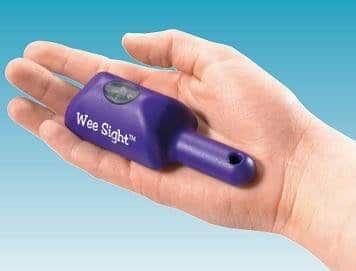
The Wee Sight is a clever little device made specifically for babies.
Its curved shape lets clinicians position a newborn’s hand or foot over the light, making small veins easier to see.
I like that it doesn’t need a large vein-viewing screen or complicated setup.
It also uses LEDs designed to produce little heat, which is especially important for delicate infant skin.
The downside? It’s designed for small limbs, so it’s not the right choice for routine adult IV access.
The LEDs do not heat up and will not hurt babies’ and toddlers’ tender skin.

Wee Sight Pros
- 629 nm red LED illumination optimized for small, superficial veins
- Flat, curved design stabilizes infant limbs
- Cool LEDs that do not heat up
- Lightweight (110 g)
- Can be used inside incubators
Cons
- Limited effectiveness on darker skin
- Designed mainly for small, superficial veins
- Higher price relative to device size
✅ Available on Amazon ($129), and at Medex ($127)
Are Vein Finder Devices FDA-Cleared?
Not every vein finder needs the same type of FDA authorization.
Some medical devices are exempt from premarket notification, while others require 510(k) clearance.
Also, FDA registration isn’t the same as FDA clearance.
If you’re buying a vein finder for clinical use, check its exact model, regulatory classification, and any required clearance before ordering.
You can verify these details using the FDA’s medical device databases.
Can You Use a Flashlight to Find Veins?
Sometimes. A bright, cool-running flashlight may help show very superficial veins, especially in small limbs.
But a regular flashlight isn’t designed or validated for clinical vein visualization, and it won’t reliably show deeper veins.
For routine medical procedures, a transilluminator or other appropriate clinical technique is a better choice.
A vein finder should always be used by a trained professional, not as a substitute for learning safe IV placement.
Final Thoughts
For emergency IV access, I’d start with the Veinlite EMS Pro. It’s portable, practical, and designed for busy clinical settings.
For sclerotherapy and vein mapping, the Veinlite LEDX offers a larger viewing area and a rechargeable battery.
The Venoscope II is a simpler option for superficial veins, while Philips Wee Sight makes more sense for newborns and infants.
Just remember that a vein finder helps you see veins. It doesn’t guarantee successful IV access, and the right device depends on the patients you treat.
To your health and happiness,
Meital
Studies
Pan CT, Francisco MD, Yen CK, Wang SY, Shiue YL. Vein Pattern Locating Technology for Cannulation: A Review of the Low-Cost Vein Finder Prototypes Utilizing near Infrared (NIR) Light to Improve Peripheral Subcutaneous Vein Selection for Phlebotomy. Sensors (Basel). 2019;19(16):3573. Published 2019 Aug 16.
Juric S, Flis V, Debevc M, Holzinger A, Zalik B. Towards a low-cost mobile subcutaneous vein detection solution using near-infrared spectroscopy. ScientificWorldJournal. 2014;2014:365902.
N.J. Cuper, J.C. de Graaff, B.J. Hartman, R.M. Verdaasdonk, C.J. Kalkman, Difficult arterial cannulation in children: is a near-infrared vascular imaging system the answer?†, British Journal of Anaesthesia, Volume 109, Issue 3, 2012,


Liked it.availability n price pls
Availability and prices are all there in the links for the products inside the post. :)